

The good bacteria in your gut breaks down the undigested fiber in your food and produces butyric acid—a short-chain fatty acid crucial for gut and brain health. While butyric acid is primarily produced in the gut, butyric acid can be directly found directly through plant oils and animal fat and indirectly through fiber-rich foods..
Butyric acid plays a key role in gut health, brain health, and overall wellness, yet many people aren’t sure where to get it or why it matters. This post breaks down what makes this multi-functional molecule so unique, explores the best sources of butyric acid, and explains when a high-quality supplement might be worth considering. . Use the links below to jump to specific topics related to the post.
The Production of Butyric Acid in the Body
The human intestine is populated with an array of bacterial flora that make up the internal microbiome. These bacteria use complex microbial pathways to ferment insoluble fiber and carbohydrates, an end-product of which is butyric acid.
The butyric acid produced by these keystone bacteria in the large intestine from the fermentation of undigested dietary fiber,however, it is the least abundant of the major short chain fatty acids produced in the colon, but is a critical substrate for the energy production of the cells that line the large intestine (colonocytes). Butyric acid contributes to 70-80 percent of the energy required by colonocytes to absorb nutrients, to maintain the gut’s protective barrier, and to ensure a balanced inflammatory response in the gut1.
How Does Butyric Acid Support Your Body?
Ongoing research on the health-promoting benefits of butyric acid indicates that it has enormous untapped potential for various health functions. The following table highlights how butyric acid production supports vital health functions in the body.*2
| How Does Butyric Acid Promote Health Functions? | |
|---|---|
| Maintaining hydration | It stimulates sodium chloride in the colon, which can help prevent dehydration3. |
| Regulating colonocyte cell cycle* | It regulates the cell cycle of colonocytes, which is a finely tuned balance between cell proliferation, differentiation, and apoptosis (cell death), which is essential for colonic health and disease prevention4. |
| Maintaining normal inflammatory responses | The presence of butyric acid helps maintain normal gastrointestinal inflammatory responses.* |
| Influencing immune responses | Butyric acid protects the intestinal mucosa from pathogens and beneficially influences the mucosa’s immune responses. |
| Regulating intestinal motility | Butyric acid helps regulate the normal movement of food through the gastrointestinal tract. |
| Maintaining normal glucose levels | A healthy level of butyric acids helps limit insulin resistance — when cells are unable to absorb glucose from the blood5. |
| Maintaining normal cholesterol levels* | The presence of butyric acid limits the intestine’s absorption of cholesterol6. |
| Promoting brain health* | Butyric acid enhances the stimulation of neurogenesis — the formation of new neurons in the brain7. |
Health-Promoting Applications of Butyric Acid
In the section above, we’ve highlighted a broad spectrum of health benefits for butyric acid. In this section, we’ll focus more specifically on Butyric’s emerging health benefits for gastrointestinal and neurologic health. For example, there is growing evidence8 supporting the influence of the gut microbiome on human brain functions via the gut-brain axis, and butyric acid (butyrate) may play a beneficial role in regulating behavior.*
The table below lists resources that further explain how butyric acid exerts beneficial effects in supporting gastrointestinal and neurological function.








Best Sources of Butyric Acid
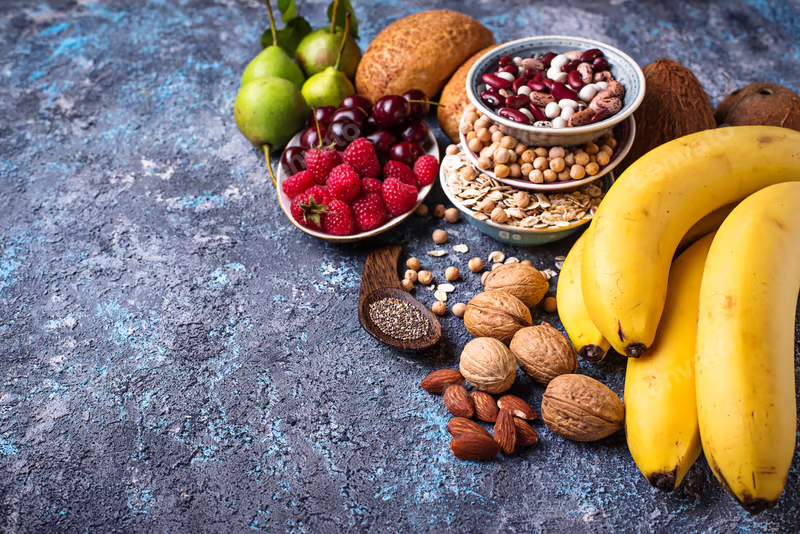
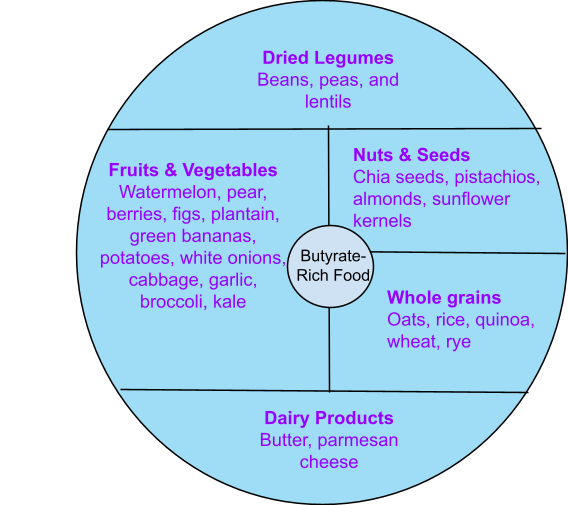
The body needs dietary fiber in order for the large intestine to produce butyric acid. Including high-fiber foods in your diet is a natural way to increase your body’s level of butyric acid– specifically, insoluble fibers.Insoluble fiber is fiber that does not dissolve in water, therefore, passes through the small intestine undigested.For example, seeds and legumes are insoluble fiber sources; since they resist digestion in the small intestine, they can be fermented in the large intestine by the gut bacteria to produce butyric acid.
The graphic below shows examples of food sources that enhance the body’s butyric acid production:
Please format this pie chart so it looks proper 🙂
When Should You Consider a Butyric Acid Supplement?
Although a fiber-rich diet enhances butyric acid production, this may not be suitable for everyone. A high fiber intake, primarily insoluble fiber, can cause uncomfortable bloating, gas, and abdominal pain, especially in those with underlying gastrointestinal conditions. Additionally, butyrate production in the body can be adversely affected by:
- Changes in the intestinal microbiome or bacterial flora
- Accelerated intestinal passage and excretion
- Potential damage to the colonocytes in the large intestine
- Certain health conditions
Any of these factors can make it difficult to consume and tolerate the sufficient amount of fiber to produce the desired level of butyric acid. A butyric acid nutritional supplement offers an easy way to enhance the level of butyrate in the intestine.
Including An Advanced Butyric Acid Supplement in Your Healthcare Plan
Although conventional butyric acid supplements include butyrate mineral salts and sodium butyrate enemas, these formulations pose absorption challenges and can have an unpalatable taste and odor.
- Butyrate mineral salts. Upon contact with the slightest amount of moisture, butyrate mineral salts emit the distinctively foul smell of butyric acid, which can make this form difficult for the user to ingest orally.
- Sodium butyrate enemas. The enema is injected rectally under medical supervision. The inconvenience of the administration process makes this a less popular option.
On the other hand, encapsulating butyric acid molecules through the proprietary technology developed by Tesseract Medical Research overcomes the obstacles to ingesting a butyric acid supplement. Tesseract’s innovative nutrient delivery technology:
- Protects the butyric acid molecules from breaking down as they pass through the stomach (enhancing bioavailability).
- Enables the slow release of the butyric acid molecules at the desired point in the intestinal tract (optimizing absorption).
FAQs: Frequently Asked Questions About Butyric Acid Supplements
Are there side effects to a butyric acid supplement?
Currently available clinical data establishes butyric acid as a safe supplement with no known toxicity. The most commonly reported side effects of oral butyric acid supplementation are mild gastrointestinal symptoms, such as nausea and headaches, which are typically transient. .
What is the recommended amount of butyric acid intake in supplement form?
The high viscosity of the contents of the intestines, and the rapid absorption of short-chain fatty acids increase the difficulty of determining the optimal amount of butyric acid supplementation. However, the recommended amount of butyric acid, as present in currently available nutritional supplements, is 150-300 mg per day.3
Can I take a butyric acid supplement with a prescription medicine?
It is always advised to consult your health-care provider before incorporating a butyric acid supplement into your healthcare plan or taking it with prescription medicine.
How do I determine the efficacy of a butyric acid supplement for supporting my gut health?
The efficacy of a butyric acid supplement is determined by the absorption and bioavailability of the butyric acid molecules. Supplement formulations using advanced encapsulation techniques display enhanced efficacy compared to non-encapsulated butyric acid.
An advanced formulation such as ProButyrate®, developed by Tesseract Medical Research, utilizes the proprietary and innovative CyLoc® – DexKey® nutrient delivery technology to boost the absorption of butyric acid molecules. The CyLoc® technology isolates and encases individual butyrate molecules in their own dextrin carrier to ensure integrity and palatability.
Tesseract’s DexKey® technology accompanies each CyLoc® molecule as a release agent to deploy targeted butyrate molecules at the desired point in the intestinal tract. The effective time-release delivery of individual butyrate molecules promotes a healthy intestinal environment, resulting in overall positive health and wellness benefits.*
The power of Tesseract supplements lies in enhancing palatability, maximizing solubility, absorption, and bioavailability, and micro-dosing multiple nutrients in a single, highly effective capsule. Shop products on our website and learn more about how they support your gastrointestinal and neurological health and well-being.*
References:
1Karim MR, Iqbal S, Mohammad S, et al. Butyrate’s (a short-chain fatty acid) microbial synthesis, absorption, and preventive roles against colorectal and lung cancer. Arch Microbiol. 2024;206(4):137. Published 2024 Mar 4. doi:10.1007/s00203-024-03834-7
2Canani RB, et al. World Journal of Gastroenterology vol. 17,12 (2011):1519-1528. doi:10.3748/wjg.v17.i12.1519
3Canani RB, Terrin G, Cirillo P, et al. Butyrate as an effective treatment of congenital chloride diarrhea. Gastroenterology. 2004;127(2):630-634. doi:10.1053/j.gastro.2004.03.071
4Gasaly N, Hermoso MA, Gotteland M. Butyrate and the Fine-Tuning of Colonic Homeostasis: Implication for Inflammatory Bowel Diseases. Int J Mol Sci. 2021;22(6):3061. Published 2021 Mar 17. doi:10.3390/ijms22063061
5Coppola S, Nocerino R, Paparo L, et al. Therapeutic Effects of Butyrate on Pediatric Obesity: A Randomized Clinical Trial. JAMA Netw Open. 2022;5(12):e2244912. doi:10.1001/jamanetworkopen.2022.44912
6Chen Y, Xu C, Huang R, Song J, Li D, Xia M. Butyrate from pectin fermentation inhibits intestinal cholesterol absorption and attenuates atherosclerosis in apolipoprotein E-deficient mice. J Nutr Biochem. 2018;56:175-182. doi:10.1016/j.jnutbio.2018.02.011
7Kim HJ, Leeds P, Chuang DM. The HDAC inhibitor, sodium butyrate, stimulates neurogenesis in the ischemic brain. J Neurochem. 2009;110(4):1226-1240. doi:10.1111/j.1471-4159.2009.06212.x
8Kalkan AE, BinMowyna MN, Raposo A, et al. Beyond the Gut: Unveiling Butyrate’s Global Health Impact Through Gut Health and Dysbiosis-Related Conditions: A Narrative Review. Nutrients. 2025;17(8):1305. Published 2025 Apr 9. doi:10.3390/nu17081305

